



Modern communication runs on context. Every channel has evolved to give the recipient something that matters more than the message itself — the power to decide whether it deserves their attention and time.
Email got subject lines. Messaging apps got previews. Even logistics operations now send a pre-arrival notification before the delivery agent is on the road. The pattern is consistent: inform first, engage second.
The phone call never got that update. It still arrives the way it did since its inception — a ring, a number, and nothing else.
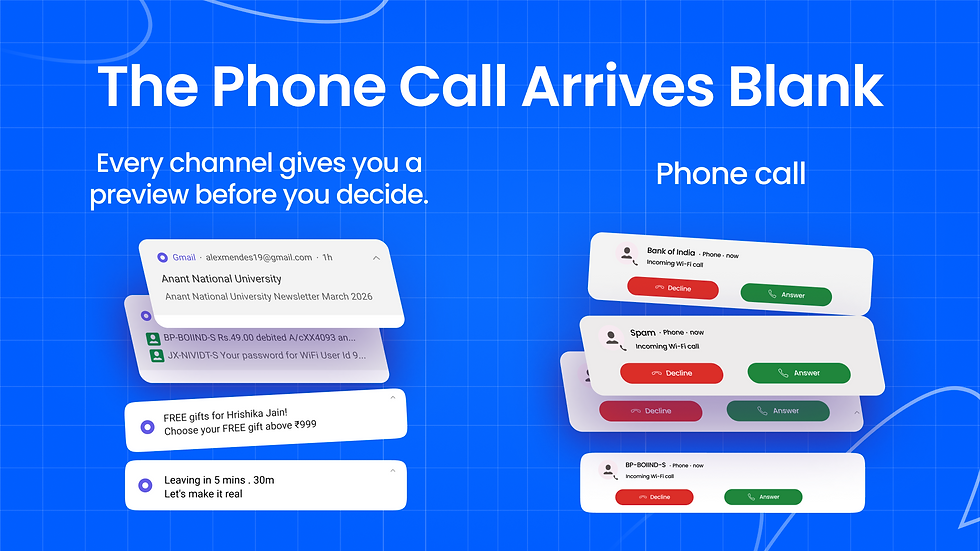
The Call That Arrives Blank
A ringing phone gives you one piece of information: someone wants your attention. It tells you nothing about why. No preview, no declared intent, no reason to decide whether to take the call or not. It comes with ambiguity.
This has a measurable consequence. Truecaller's data suggests that, by default 79% of customers actively avoid calls from numbers they do not recognise.
Calling more frequently does not move that number. The problem is not volume. It is that the call arrives without context, and it takes a split second — that is how long a receiver takes to decide whether to answer or not. And this is exactly where most brands suffer. They do not know how to win that split second from the receiver.
What That Split Second Costs
That split second never gets logged as a communication failure. It shows up elsewhere:
Failed delivery. Unknown number. Ignored. Re-attempted at a cost that should never have existed.
Lapsed policy. Renewal call unanswered. Policy expires. Re-acquisition costs more than retention ever would.
Missed KYC verification. In a regulated environment, a missed call does not delay the process — it restarts it.
The cases vary. The reason is always the same — the call was made, the intent was legitimate, and the process failed because intent was not visible to the recipient.
One Line to Change It All
What if phone calls too had a feature that told the receiver the intent of the call, before they even decided to pick up? A Call Reason is exactly what was needed to make that happen.
A Call Reason is a short, clear message that appears on your customer's screen the moment your call arrives, before they decide to pick up or decline.
The customer sees why you are calling before they choose to answer. That single line of visible intent is what transforms a declined call into a completed conversation.
"Your order is out for delivery. Calling to confirm your address." "Regarding your loan application." "Your policy renewal is due. Calling to assist."
Same calls. Same agents. Same customer. The only difference is that this time, the intent is visible — and it gets answered.
Call Reason by Truecaller for Business
Every call your business makes can now carry a reason — controlled, personalised, and ready at the moment the call is placed.
Write it yourself: Fixed, on-brand call reasons for specific workflows — consistent across every agent and campaign.
Personalise it dynamically: API-enabled personalisation feeds in customer name, language, situation, or journey stage directly into the call reason. A loan applicant sees a different reason than a policy renewal customer. A call that feels tailored never feels like outreach.
Generate it with AI: Define your use case and instantly get optimised call reasons in three tones: Conversational, Direct, or Professional. No copywriting struggle, no guesswork. Better answer rates, stronger customer engagement, and calls that drive action from the first attempt.
What the Numbers Confirm
A 3x improvement in pickup rate does not mean more conversations. It means fewer failed deliveries, fewer lapsed policies, fewer compliance delays — resolved at the first attempt instead of the third. According to Truecaller-proprietary data:
3x improvement in pickup rate with personalised, situation-specific call reasons
2x improvement in pickup rate with standard contextual messaging
2x increase in average call duration — customers who answer with context resolve more in a single conversation
Every percentage point is a business outcome previously lost in a two-second window nobody was measuring.
The Last Channel Without Context
For years, the phone call was the only communication channel without context. Every other channel evolved to deliver attention and context together. The phone call only ever delivered one.
Attention today is conditional. And the condition is clarity.
Call Reason by Truecaller embeds intent into every call — turning interruptions into informed interactions. Not by changing user behaviour, but by finally respecting it.


Comments